
If you’ve been browsing IT job boards in Sydney or Melbourne lately, you’ve noticed a shift. DevOps roles that once listed ‘security awareness as a bonus’ now demand hands-on experience with CI/CD security pipelines, policy-as-code frameworks, and SOCI Act compliance workflows. That shift has a name: DevSecOps. And in 2026, it is no longer a nice-to-have it’s a condition of employment in Australia’s most critical industries.
This guide explains exactly what DevSecOps and shift-left security mean, why Australian regulatory changes are accelerating demand at a pace unlike anywhere else in the Asia-Pacific, and how Microsoft’s AZ-400 DevOps Engineer Expert certification is becoming the go-to credential for IT professionals who want to prove they’re ready.
What Is DevSecOps and What Does 'Shift-Left' Actually Mean?
Traditional software development treated security as a final gate. Vulnerability testing happened right before deployment, meaning any issues found triggered expensive rework, project delays, and unacceptable risk windows. DevSecOps fundamentally changes this model by integrating security practices into every stage of the development pipeline from the first line of code to production monitoring.
The term ‘shift left’ comes from how software development pipelines are visualised: left to right, from planning through to deployment. Shifting security left means moving it earlier into the planning phase, code commits, pull requests, and CI/CD pipelines long before code ever reaches a live environment.
70% of security teams now confirm that security has already shifted left within their organisations.
Source: ISC2 2025 Workforce Study — but the skills to support that shift remain critically short, with 59% of teams reporting significant gaps.
In practice, a DevSecOps engineer embeds automated security testing (SAST and DAST) directly into version control and build pipelines, manages secrets and credentials securely, scans containers and Kubernetes workloads, enforces infrastructure-as-code security policies, and generates Software Bills of Materials (SBOMs) for supply chain risk management all before any code reaches production.
Why Australia Is Feeling the Pressure More Than Most

Australia is operating under one of the most demanding regulatory cybersecurity environments in the Asia-Pacific region in 2026. Two interlocking forces are creating an urgent, measurable demand for DevSecOps skills specifically.
1. The SOCI Act: From Documentation to Evidence
The Security of Critical Infrastructure Act (SOCI Act) now covers 22 asset classes across 11 critical sectors from energy and financial services to higher education, data storage and processing, and telecommunications. Every responsible entity must maintain a Critical Infrastructure Risk Management Program (CIRMP), with board-approved annual reporting, mandatory cyber incident reporting within 12 hours, and vulnerability testing requirements under Enhanced Cyber Security Obligations for Systems of National Significance.
The critical shift in 2026 is regulators’ expectations. Documentation alone is no longer sufficient. The Australian Cyber and Infrastructure Security Centre (CISC) expects evidence that controls are actively operating running CI/CD pipeline scans, automated test outcomes, supply chain assessments, and incident simulation records. That operational evidence trail is precisely what a mature DevSecOps pipeline generates automatically.
For organisations in Victoria, April 2026 marked the close of the first mandatory CIRMP annual reporting period, and as one compliance platform noted regulators have shifted from education to enforcement. Non-compliance now carries daily financial penalties for entities whose risk programs are found to be ‘seriously deficient.’
📋 SOCI Act Quick Facts for IT Teams:
- 22 asset classes across 11 critical sectors now in scope
- CIRMP annual reporting is mandatory and board-approved
- Cyber incidents must be reported to ACSC within 12 hours
- Penetration testing and vulnerability assessments required for SoNS
- Supply chain and third-party vendor security now a key compliance gap area
2. The Cybersecurity Act 2024 and Secure-by-Design Mandates
The Cybersecurity Act 2024 builds on SOCI with ransomware payment reporting obligations, IoT security standards (commencing in staged rollouts through 2026), and a legislative push toward secure-by-design as an industry standard not an aspiration. For software teams, this means the expectation that security is engineered in from day one, not retrofitted at deployment.
Market forces are reinforcing this regulatory pressure. Buyers in the enterprise and government space now demand proof of security hygiene: ISO 27001 compliance, regular penetration test records, and evidence of secure coding practices have become deal-breakers in procurement decisions. Cyber insurance providers increasingly require these controls before issuing policies.
SysCare’s Microsoft AZ-400 (DevOps Engineer Expert) training in Melbourne and Sydney equips your team to build secure
CI/CD pipelines, automate compliance checks, and produce the SOCI Act operational evidence regulators now require.
Book your seat → syscarepro.com.au/az-400
What Employers in Sydney and Melbourne Are Actually Demanding
Current hiring activity across Australian job platforms reflects a clear pattern: organisations are not looking for developers who have heard of DevSecOps. They are looking for professionals who can demonstrate it. The most in-demand DevSecOps technical skills in 2026 include:
- Automating security testing (SAST/DAST) within Azure Pipelines and GitHub Actions
- Infrastructure as Code (IaC) security using Terraform, Azure Bicep, or ARM templates
- Policy-as-code enforcement with Open Policy Agent (OPA) for real-time pipeline compliance
- Container and Kubernetes security scanning (Trivy, Prisma Cloud, or equivalent)
- Secrets management and credential governance (Azure Key Vault, HashiCorp Vault)
- SBOM generation and supply chain risk management practices
- Incident detection, logging, and SIEM integration within DevOps workflows
Hiring managers are placing a premium on candidates who can enable delivery teams to move fast and securely professionals who embed security controls into existing workflows rather than creating friction or bottlenecks. Strong DevSecOps resumes in 2026 lead with outcomes: percentage reduction in vulnerabilities reaching production, time-to-fix improvements, and SOCI-aligned audit evidence generated.
DevSecOps Engineer is one of the top 5 fastest-growing cybersecurity roles in Australia for 2026.
Source: Pulse Recruitment Australia — organisations embracing agility report that the DevSecOps specialist has become indispensable.
The Microsoft Certification Path for DevSecOps in Australia

For IT professionals in Australia looking to formalise and validate their DevSecOps capabilities, the Microsoft Azure certification path is among the most employer-recognised routes available and SysCare Professional IT Training is an accredited Microsoft Learning Partner in Melbourne and Sydney.
2. The Cybersecurity Act 2024 and Secure-by-Design Mandates
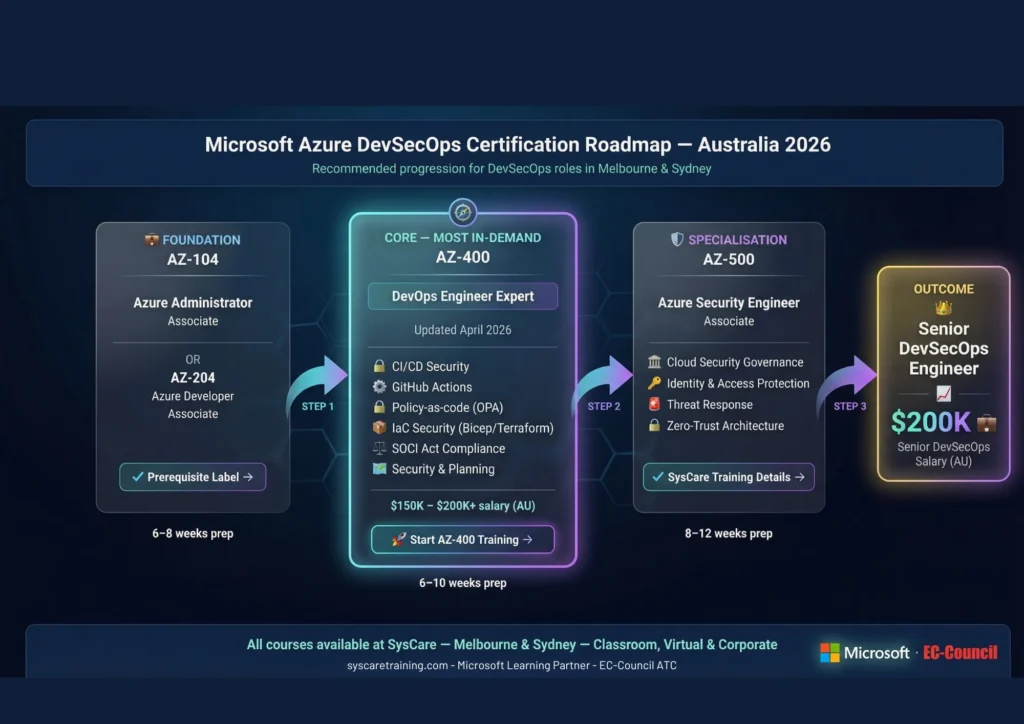
- AZ-104 (Azure Administrator Associate) or AZ-204 (Azure Developer Associate) – foundational Azure proficiency required as a prerequisite for AZ-400
- AZ-400 (DevOps Engineer Expert) – the core credential, covering CI/CD pipeline design, source control strategy, security and compliance planning, release management, and feedback loops
- AZ-500 (Azure Security Engineer Associate) – for professionals who want to specialise further in cloud security governance, identity protection, and threat response within DevSecOps environments
The AZ-400 exam measures your ability to design and implement processes and communications, build and release pipelines, develop security and compliance plans, and implement instrumentation strategies. It is being updated in April 2026 to reflect the latest Azure DevOps and GitHub integrations making now the ideal window to train with current course material and sit the updated exam with confidence.
Senior Azure DevOps Engineers in Australian IT hubs command salaries from $150,000 to $200,000+ in 2026.
AZ-400 certified professionals are in high demand across enterprise platform teams, SaaS companies, and government technology programmes.
DevSecOps Is Not Just for Developers
One of the most persistent misconceptions about DevSecOps is that it is exclusively relevant to software engineers. In reality, a wide range of IT professionals stand to benefit and are increasingly expected to hold these skills:
- Security analysts and SOC professionals: understanding how vulnerabilities enter the pipeline and are detected automatically is now expected knowledge in most mid-to-senior security roles
- Cloud and infrastructure engineers: IaC security, policy-as-code, and pipeline governance are core cloud engineering competencies in 2026
- QA engineers and test leads: automated security testing is now part of the testing lifecycle, not a separate function
- IT project managers and delivery leads: understanding DevSecOps practices is increasingly required to manage SOCI Act compliance obligations and provide evidence of operational controls to boards and regulators
For security professionals moving from traditional perimeter or SOC roles, DevSecOps represents a significant career and salary expansion with the added job security that comes from being embedded in the development lifecycle rather than peripheral to it.
How SysCare Prepares Australian IT Professionals for DevSecOps Roles
SysCare Professional IT Training delivers Microsoft-accredited AZ-400 and AZ-500 training across Melbourne and Sydney, with flexible delivery options designed for working professionals:
- Classroom training: instructor-led, hands-on lab environments in Melbourne CBD and Sydney CBD
- Live virtual training: real-time, instructor-led sessions accessible Australia-wide
- Corporate cohort training: customised, on-site or virtual delivery for teams of 5 or more, aligned to your organisation’s Azure environment and SOCI compliance context
- Blended learning packages: pre-course e-learning combined with intensive workshop sessions
ENROL TODAY — AZ-400 DevOps Engineer Expert | AZ-500 Azure Security Engineer
Upcoming course dates: Melbourne & Sydney — April, May, June 2026
SysCare accredited partners: Microsoft Learning Partner | EC-Council ATC
Book your seat or request a corporate training quote → syscarepro.com.au/contact
Frequently Asked Questions (FAQPage Schema)
What is DevSecOps and why does it matter for Australian businesses?
What Microsoft certifications are best for DevSecOps roles in Australia?
Do I need a software development background to get into DevSecOps?
Is DevSecOps required for SOCI Act compliance in Australia?
How long does it take to get AZ-400 certified in Australia?
READY TO GET CERTIFIED?
SysCare Professional IT Training Accredited Microsoft Learning Partner | EC-Council ATC
AZ-400: DevOps Engineer Expert | AZ-500: Azure Security Engineer | CEH: Certified Ethical Hacker
Classroom | Live Virtual | Corporate Cohort — Melbourne & Sydney
Enrol Now